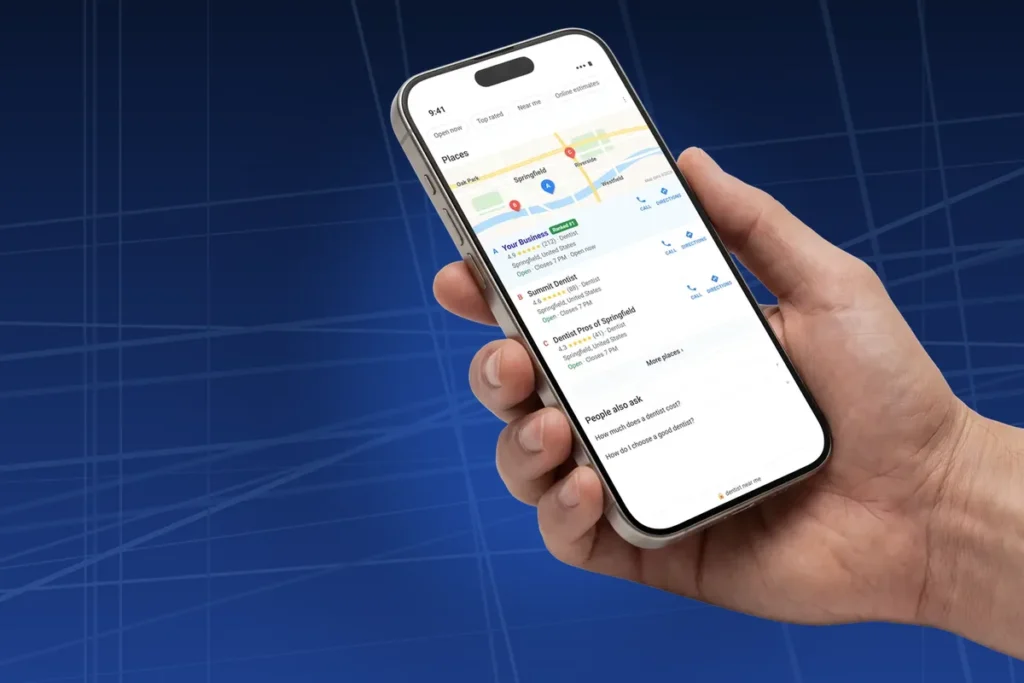
To rank higher on Google Maps, you need three things working together: a Google Business Profile that clearly matches what people search for, a steady flow of genuine reviews, and a website and local reputation that prove you are a real, established business. Google says local results come down to relevance, distance and prominence, and you can influence two of those three.
Whether you think of it as learning how to rank in Google Maps or getting into the map pack, there is no trick, no paid shortcut and no setting that jumps you to the top. What works is unglamorous: getting the basics exactly right, then doing a few things consistently for months while your competitors get bored. This guide walks through what that looks like for a local business owner, in plain terms.
Google Maps Rankings at a Glance
- Google ranks local results on three factors: relevance, distance and prominence
- Your categories affect your ranking, so pick the most specific primary category that describes what you are
- Reviews count, both how many you get and whether you reply to them
- Your website supports your profile, especially clear service pages and consistent contact details
- You cannot pay Google for a better map position, and fake reviews or keyword-stuffed names can get your listing suspended
Most businesses that struggle in the map pack are not losing to clever competitors. They are losing to their own incomplete profile.
On this page
How Google Decides Who Shows Up in the Map Pack
When someone searches for a local service, Google usually shows a map with a short list of businesses under it. That block is what people call the map pack, and it often sits above the regular search results. Only local businesses appear in it, not national portals or directories, which is why a real estate agent who will never outrank Zillow for a listing search can still win the map, the starting point of SEO for real estate agents. On Google Maps itself, the same logic decides the order of the list. Google's own explanation of local ranking names three factors.
Relevance
Relevance is how well your profile matches what the person typed. If someone searches for "emergency plumber" and your profile says you are a plumber, lists emergency service and describes it, you are relevant. If your category is something vague and your description is two lines long, Google has less to go on. This is the factor you control most directly.
Distance
Distance is how far your business is from the person searching, based on the location they share or what Google knows about where they are. You cannot move your business, and you should not try to fake a location. What you can do is make sure Google knows exactly where you are and which areas you serve, so you compete properly near your base.
Prominence
Prominence is how well known your business is. Google says this looks at how many websites link to your business and how many reviews you have, and that more reviews and positive ratings can help. A business that has been around for years, gets talked about locally and collects reviews steadily tends to rank above a newer business with a similar profile.
The practical takeaway: you can fully control relevance, partly control prominence, and you have to accept distance. Everything below works on the first two.
Get Your Google Business Profile Right First
Your Google Business Profile is the listing that appears on Maps. Before you think about anything else, get it verified, complete and accurate. Google lists exactly these steps as ways to improve local ranking, and a surprising number of profiles still skip them.
Pick the Right Primary Category
Your primary category is one of the most important choices on the profile, and Google says the categories you select affect your local ranking. Google's guidelines say to use as few categories as possible and to pick ones that complete the sentence "this business is a." Choose the most specific option that fits, for example "Electrician" rather than "Contractor." Add secondary categories only for things you genuinely are, not for every service you offer. Getting categories, services and descriptions to line up is a big part of what I do in my Google Maps SEO services, because it is where many profiles quietly lose relevance.
Use Your Real Business Name
Your name on the profile should match your real-world name, the one on your van, invoices and website. Adding keywords like "Best Plumber Dallas" to the name breaks Google's rules, and it can get the listing suspended. If a competitor does it and seems to get away with it, that is a reason to report them, not to copy them.
Fill In Every Field That Applies
Complete your hours, phone number, website, services, business description and attributes. Keep holiday hours up to date. Add real photos of your work, your team and your vehicles, not stock images. Google specifically mentions adding photos and keeping information complete and current as ways to help your ranking. Each field gives Google one more reason to show you for a relevant search.
Set Your Service Area Honestly
If you visit customers rather than having them come to you, you are a service-area business. Google's guidelines for representing your business say service-area businesses should hide their address, that virtual offices and P.O. boxes are not allowed, and that your service area should generally stay within about two hours' drive of your base. Listing a huge area will not make you rank everywhere in it. Distance still applies.
Earn Reviews the Right Way
Google says more reviews and positive ratings can help your local ranking. Reviews also do something just as important: they convince the person looking at your listing to call you instead of the business next to you on the map.
Ask Every Happy Customer
The businesses with the most reviews are rarely the ones with the most customers. They are the ones that ask every time. Send your review link by text or email right after the job, while the customer is still pleased. Make it one tap. A simple "Would you mind leaving us a quick review? It really helps a small business" works better than any script.
Reply to Every Review
Google lists responding to reviews as one of its own tips. Thank people for good reviews in a sentence or two, and mention the job where it is natural. For bad reviews, stay calm, acknowledge the problem and offer to sort it out offline. Future customers read those replies, and a fair response to a complaint often builds more trust than another five-star review.
What Not to Do
Do not buy reviews, write them yourself, ask staff or family to post them, or offer discounts in exchange for them. Google's Maps content policy prohibits reviews that are paid for or incentivized and reviews from people with a conflict of interest, and it removes them. The risk is not worth it, especially when honest review requests work.
Make Your Website Back Up Your Profile
Your profile links to your website, and Google looks at both. A strong website does not replace a good profile, but a weak or missing one holds a good profile back.
A Page for Each Main Service
Give each core service its own page that explains what you do, where you do it and how to book. Take an electrician as an example: a page each for panel upgrades, EV charger installation and emergency call-outs tells Google far more than one page that lists everything in a sentence. It also gives the person who clicks through from Maps a clear reason to call. This is the same approach I use for electrician SEO, and it applies to almost any trade.
Keep Your Name, Address and Phone Consistent
Your business name, address and phone number should be the same on your website, your profile and the main directories you are listed on. Mismatched details, an old address or a tracking number that differs everywhere make it harder for Google to be sure all those mentions are the same business.
Earn Local Mentions and Links
Prominence grows when other people talk about you. Sponsor a local team, join your chamber of commerce, get listed with trade associations and suppliers, and say yes when local news or community sites want to feature you. None of this happens in a week, which is exactly why it separates established businesses from new ones.
This is not theory for me. On an electrician site and a plumbing site I work on, this combination of profile work, reviews and service pages produced 744 calls from Google Search and Maps in six months, with no ads.
Deal With Spam Listings in Your Area
In some trades the map pack is full of fake listings: made-up business names stuffed with keywords, addresses that are empty lots, and dozens of profiles that all ring the same call center. Locksmiths and other 24/7 emergency services are hit hardest, because people searching in a panic call the first number they see. If that is your trade, cleaning up spam around you can matter as much as improving your own profile, and it is a big part of SEO for locksmiths.
On Google Maps you can use the "Suggest an edit" option on a listing to report a fake name, a wrong address or a business that does not exist. Report specific facts, keep a note of what you reported, and check back. It is slow, and not every report succeeds, but each fake listing removed is one less business standing between you and a customer.
What Will Not Help (and What to Expect)
A lot of money gets wasted on Maps tactics that do nothing or carry real risk. Be wary of anyone offering any of these:
- Paying for a better position. Google is clear that there is no way to request or pay for a better local ranking. Ads can appear near the map results, but they are marked as sponsored and are separate from your organic position.
- Keyword-stuffed names and fake addresses. They can work briefly, then the listing gets suspended and you start again.
- Bulk directory submissions. A handful of accurate, relevant listings beats hundreds of junk ones.
- Guaranteed number one rankings. Nobody can promise this, because nobody controls Google. A guarantee is one of the classic SEO scams.
As for timing, profile fixes can show some movement within weeks, while reviews and local prominence build over months. If you want a fuller picture of realistic timelines, how long SEO takes covers it in more detail.
Frequently Asked Questions
How Long Does It Take to Rank Higher on Google Maps?
It depends on where you start and how competitive your area is. Fixing an incomplete profile or a wrong category can help within a few weeks. Building reviews and local prominence is a months-long effort. In a busy city for a competitive trade, expect it to take longer than in a small town.
Can I Pay Google to Rank Higher in the Map Pack?
No. Google states there is no way to request or pay for a better local ranking. You can buy ads that appear near the map results, but they are labeled as sponsored and do not change where your business ranks organically.
Do I Need a Physical Address to Show Up on Google Maps?
You need a real business location that Google can verify, but you do not have to show it. If you serve customers at their home or business, Google's guidelines say to hide your address and set a service area instead. Virtual offices and P.O. boxes are not allowed.
Why Do I Rank in One Part of Town but Not Another?
That is distance at work. Google weighs how close a business is to the person searching, so you will usually rank best near your location and weaker farther away. Strong relevance and prominence can stretch that radius, but they cannot remove it.
Should I Put Keywords in My Business Name?
No. Google's guidelines say your name should reflect your real-world business name, and adding keywords breaks that rule. It can get your profile suspended. If your real, registered name already includes your trade, that is fine.
Can I Improve My Map Rankings Myself?
Yes, much of it. Choosing the right category, completing your profile, asking for reviews and replying to them are all things an owner can do well. Where SEO expert services earn their keep is in competitive markets, spam-heavy trades and website work. Can I do SEO myself covers where that line usually sits, and if you do hire someone, how to choose an SEO company walks you through the questions to ask.
Where to Start This Week
If you only do three things, do these: check that your primary category is the most specific one that fits, fill in every empty field on your profile, and start asking every happy customer for a review. Those three steps cost nothing and fix the problems that hold most local businesses back.
If you have done the basics and you are still stuck below competitors who do not seem to deserve it, that is when freelance SEO help starts to pay for itself. I work directly with a small number of local businesses, and I am happy to look at your listing and give you an honest view of what is holding it back. Tell me about your map rankings and I will tell you where I would start.
Ranking factors, profile rules and review policies in this guide come from Google's Business Profile Help Center and Maps content policy, linked above. The call figure refers to two trade sites I built and ranked, combined, from organic search and Google Maps with no ad spend.